*Linear Notes to my new CD*
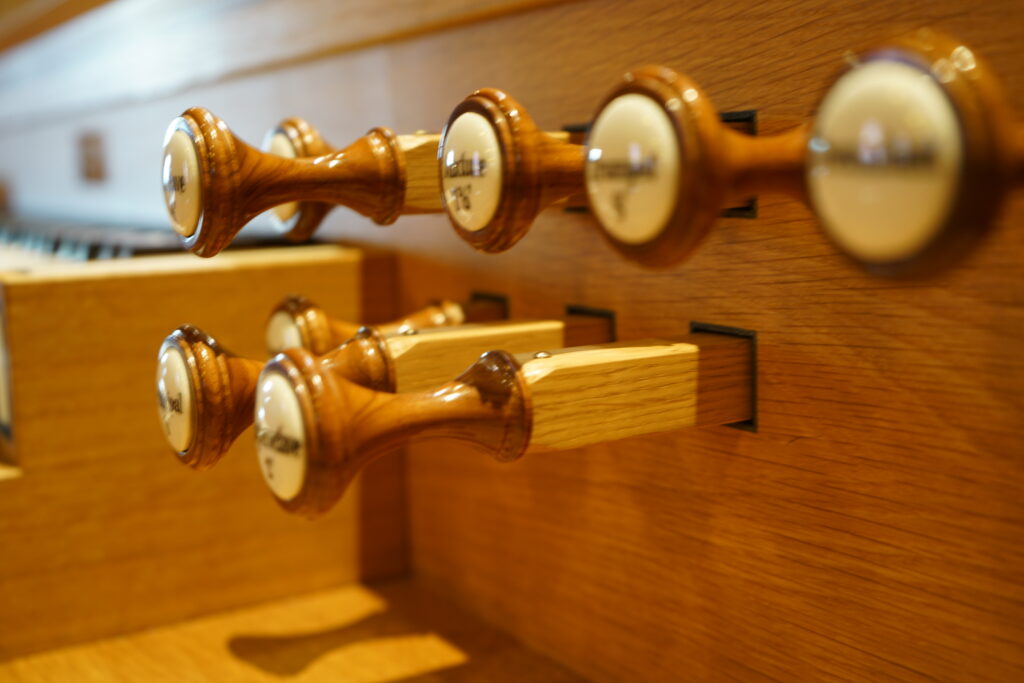
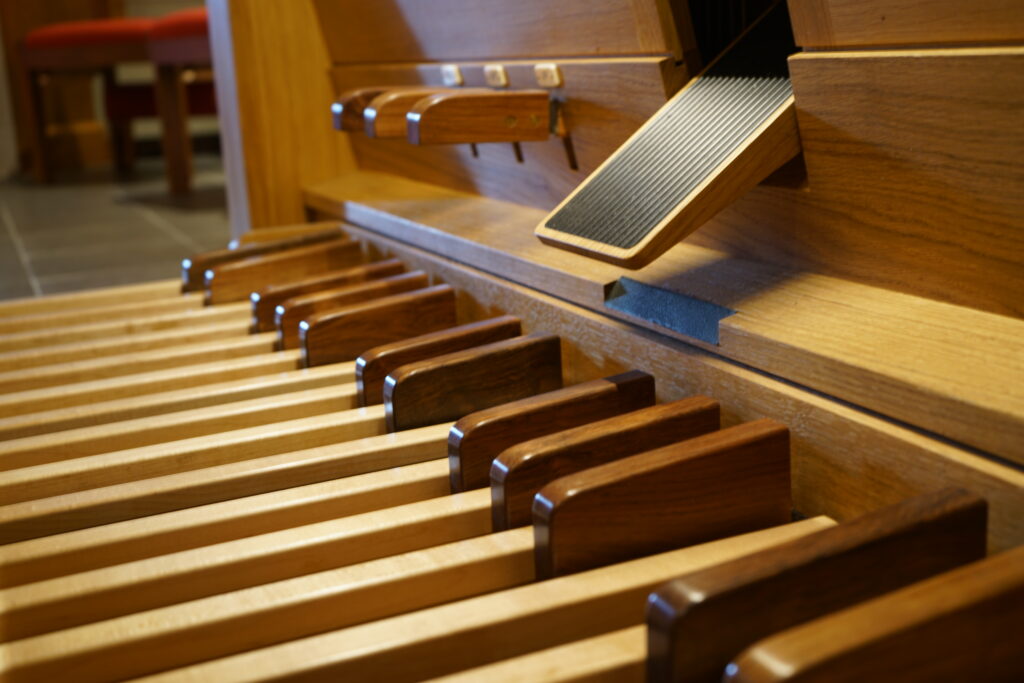
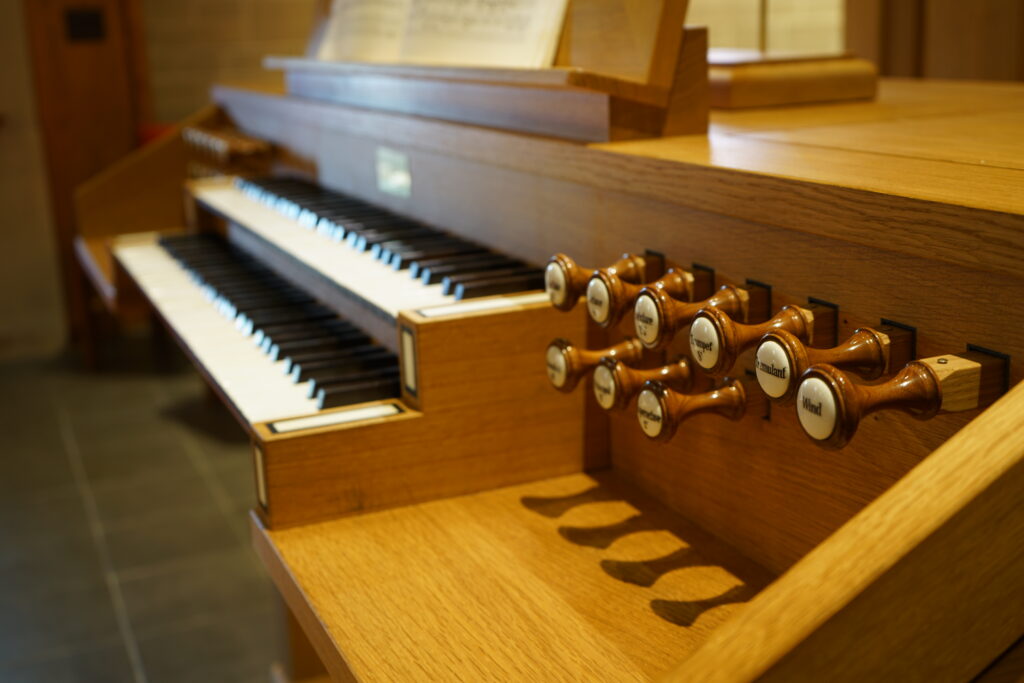
The Pasi organ at Grace Episcopal Church in Holland, MI has been a favorite instrument of mine since its installation, especially because of the beautiful sounds and sensitive action. As I planned a recital program for the 2018 Great Lakes Regional convention of the American Guild of Organists, I wanted to show off the ways this instrument could bring to life the literature I’d spent focusing on during the year of my Fulbright and after, as I studied with Prof. Harald Vogel the music of 17th and 18th century North Germany. But I had another repertoire focus, as well as a bone to pick – with the organists and organ lovers who assumed that an organ like this could “only” play the music of Bach and the Baroque. My years exploring organs built in this style, and finding ways to program diverse repertoire on them, proved differently, and I was excited to show my audience a wide variety of literature, especially composers and pieces they might not have encountered before. So I wanted to also include music by women written in the 21st century. This “Beyond Bach” recording includes the pieces played in that recital, plus a few extra.
Bach – Concerto in A Minor
Pablo Casals famously wrote in his biography that for 80 years he’d been playing Bach first thing every morning, and found it essential to his daily life. He compared Bach’s music to the miraculous in nature. While I can’t claim such a principled routine around Bach, I also find playing his music to be soul-cleansing. This arrangement or transcription by Bach of a Vivaldi concerto into a solo organ piece was one that I learned for the monthly recitals Prof. Vogel held in Bremen’s St. Martini church, on the magnificent organ built by North German master-organ builder Jugend Ahrend. At St. Martini church, the students of Prof. Vogel performed the complete organ works of J.S.Bach in a series of concerts. This was an incredible learning experience for me, both in terms of the pieces I learned and performed myself, and also as I listened to fellow students, since we were often pulling stops and turning pages for one another. On the day I first performed this piece, in that series of concerts, Prof. Vogel commented that it is one of the most difficult pieces in the repertoire. With two separate pedal lines, one for each foot, plus totally different rhythmic patterns in the right and left hands, it sometimes feels the way I imagine riding a unicycle while juggling and playing a harmonica must feel. The opening and closing movements are full of energy and excitement, while the slow middle movement features a repeated accompaniment line in the left hand, and a lyrical ornamented melody line in the right hand.
McDowall – Church Bells Beyond the Stars
As I was looking for new pieces by living women composers to play, around 2014, another organist who knew I had recently discovered Rachel Laurin suggested the English composer Cecilia McDowall to me. I emailed her, as her organ pieces were not yet published, and she graciously sent me gallery proofs of a new set of three pieces, all inspired by the British poet George Herbert’s piece entitled Prayer I. It’s a slightly esoteric rumination, with wonderful images and sounds cascading from start to finish. I’ll admit that I chose to learn this piece solely because I loved the title. I’m a huge fan of church bells, and what an evocative image, the church bells beyond the stars! This piece uses a pealing affect, repeating patterns that shift and change their rhythmic emphasis just sightly but continuously. The middle section is a beautiful, haunting melody that takes us to the ethereal realm beyond the stars.
Prayer (I) by George Herbert
Prayer the church’s banquet, angel’s age,
God’s breath in man returning to his birth,
The soul in paraphrase, heart in pilgrimage,
The Christian plummet sounding heav’n and earth
Engine against th’ Almighty, sinner’s tow’r,
Reversed thunder, Christ-side-piercing spear,
The six-days world transposing in an hour,
A kind of tune, which all things hear and fear;
Softness, and peace, and joy, and love, and bliss,
Exalted manna, gladness of the best,
Heaven in ordinary, man well drest,
The milky way, the bird of Paradise,
Church-bells beyond the stars heard, the soul’s blood,
The land of spices; something understood.
Böhm – Chorale Preludes
All of the 16th and 17th century composers on this disc were ones whose music I became much more familiar with during my years spent studying in Germany, because they were the repertoire in which my teacher there specialized in, and which I’d made the topic of my Fulbright study. Many of them I heard him, or my fellow students, perform in recitals or classes. Georg Böhm is a composer who left us 3 Praeludium – multi-sectional works not based on a hymn tune – plus 20 settings of German chorales (hymn tunes) of his day. These pieces all use the structure of an ornamented melody in the right hand, with pedal and two accompanying voices in the right hand. They are a perfect way to show off beautiful individual stops and unique sound combinations, as I worked hard to use very different sound combinations for each chorale prelude.
Prelude, Aria, and Finale – Sandresky
An organist friend first introduced Margaret Sandresky to me, and her fascinating piece Five Sacred Dances. I appreciated the melodic nature of her works and gradually learned more and more. At some point, I began thinking it could be fun to celebrate her advancing age by playing a birthday concert, perhaps when she was around 97. At the time, it seemed one shouldn’t wait too long for such a celebration, since who knew how long she would stay healthy. It didn’t work out at that time to find a venue for that idea,but then a few years later the pandemic happened, and suddenly I had the time to put together a program (now for her 100th birthday!) and perform it at Calvin University, where I teach. She was still feisty and doing well, and one benefit of those strange pandemic days was that everyone was home, so she was able to watch the livestream of my concert, and email me afterwards to thank me for the performance. At the time, she was still composing very regularly, and while that isn’t the case any longer, I heard from colleagues that she recently celebrated her 105th birthday. Perhaps the life of an organist/teacher/composer/performer has kept her curious, active, and healthy. This triptych is one of her most recent compositions, which I’ve performed often, including on that 100th birthday concert.
Prealudium in F Major – Buxtehude
Buxtehude was the composer who started my North German Fulbright quest. I especially loved playing his works in grad school, and as I listened to Prof. Vogel’s recordings of Buxtehude’s pieces (on LPs in the library!) during a semester when I was teaching organ literature to college students, the idea formed in my head to apply for a Fulbright grant to study Buxtehude with him in North Germany. During my Bremen years, we also played the complete works of Buxtehude in a series of many concerts, and I’d still love to replicate that feat by myself at some point. For now, I’m slowly working through learning all his pieces on my own, and this was a newish discovery for me more recently. It contains all the hallmarks I love about Buxtehude, a colorful harmonic language, jaunty fugue subjects, drama and excitement.
Three Fugues — Laurin
The first pieces I learned by Rachel Laurin were these fugues, from her first book of 12 short pieces, for a concert I played in Toronto, but after having caught the RL bug, I didn’t stop there. I bought more of her eventual 6 books of 12 short pieces, as well as a number of other works. While everything she wrote was brilliant, idiomatic for the organ, and full of color, I came back often to the miniatures in her Twelve Short Pieces because, though Laurin was clearly a massively talented performer (and wrote virtuosic pieces that showcase this) she didn’t shy away from easier writing, and nothing shows a composer’s talent better than being willing to distill their ideas down into a short form. Laurin is a master of the miniature form, and these pieces are every bit as well-composed as her gigantic concert works, (and sometimes, even more fun…) She wrote a whole set of “shape fugues” – circular, square, triangle,
We began exchanging correspondence at some point, when I wrote to ask her about a new piece, and when she wrote back with a preliminary copy of the score, she covered the envelope with cat stickers, and included a hand-written note. I don’t imagine I was too unique in this respect, I think she was always unpretentious, fun and disarming with everyone she came into contact with. It was a shock to hear about the cancer diagnosis that eventually took her life
It’s certainly cruel, that such a brilliant composer didn’t have longer to create, and that we didn’t have longer to enjoy her, but what a wealth of treasures she left us – her voice certainly lives on each time we perform her music. And she certainly left us plenty of practicing to do in her absence.
In dich hab ich gehoffet, Herr – Scheidemann
Scheidemann is the only North German composer on this CD whose works we (the students of Prof. Vogel’s) didn’t perform in a series of “Complete Works” concerts during my Bremen years. I remember him saying once in passing that there were too many Magnificat settings (7 – one for each of the church modes). Perhaps it was more that those settings, plus the 35 chorale settings, plus 12 motet intabulations, just seemed like too much of a good thing. Maybe, maybe not… Julia Brown’s 7 CDs of the complete organ works of Scheidemann do indicate how long it would have taken us, and Scheidemann can be something of an acquired taste. But though his music is the oldest represented here, from the early to mid-17th century, I find it very compelling. Though his is a time far removed from our own, there is a vitality and harmonic inventiveness that is unmatched. This piece consists of three sections, or verses. Versus I has the melody in the pedal. Versus II display it in the top voice of the right hand, in a manualiter movement – without pedal. And Versus III returns to the melody in the pedal. For each movement, we hear a different combination of sounds, with the pedal trumpet used to bring out the cantus firmus (chorale melody) in the pedal. This is the second setting Scheidemann made of this hymn tune and text. This plaintive text, written in 1533, was combined with the melody not long after, and became a very popular chorale in Protestant Germany, set by many composers, including later Bach.
In you I have placed my hope, Lord,
help, so that I may not be ruined
or forever despised.
I ask this of you, uphold me
in your love, my God.
Van Ness – Movements from Pastoral Suite
Most composers of organ music are organists themselves, as the organ is often an baffling instrument for those not familiar with it – the unique sonic challenges and possibilities, the techniques of playing, which are similar to the piano, and yet different. But occasionally, a composer approaches the organ without the many ingrained expectations and habits that an organist would have, because they don’t play themselves. It can be fascinating to see how these composers choose to deal with the organ. Patricia Van Ness has had a long association with First Church in Cambridge, MA, as the composer-in-residence there, where she’s composed a huge repertoire of choral music, and her music is highly influenced by medieval church music. All those influences are apparent in this suite – originally 4 movements, it was later expanded to 7. Three of the movements are included on my CD, all based on sacred texts, either from the Episcopal liturgy, Psalm passages, or hymns with texts and tunes by Van Ness. Here, “You lead me beside the still waters” is from Psalm 23, “Our life, our sweetness, and our hope” is from the Liturgy of the Hours, and “You have put into my heart a marvelous love” is from Psalm 16, in a translation from the Liturgy of the Hours.
Lübeck – Praeludium in G Minor
I believe I first heard this piece when a fellow student play it during the recitals when we students played the complete works of Vincent Lübeck. The piece is a good example of why I wanted to study with Prof. Vogel and play the organs of North Germany – all the drama, so many colors, with a language so unfamiliar and yet so compelling. This particular piece features that most unfortunate of issues – a devilishly hard section that doesn’t sound particularly so! Here, it’s in the second section, a fugue in five voices, with two of those voices played in the feet. This means each foot plays one of the fugal voices, while the right hand plays two more, and the left hand plays the fifth voice. Again, it doesn’t sound that hard, but learning counterpoint like this will make your brain hurt, until the moment when it all clicks into place. Like some kind of logic problem or optical illusion, once you’ve figured it all out, it’s not terrible. Like riding a unicycle, perhaps? Typical of a North German Praeludium, there are a number of different contrasting sections, each with its own new choice of registrations.
Decker – Tango Toccata on a Theme by Melchoir Vulpius
Pamela Decker is an American composer, performer, and teacher who has taught at the University of Arizona for decades and is one of her generation’s leading organist composer/ performers. She has been very influenced by her years living in the Southwest, both writing pieces inspired by the flora and fauna, and using musical forms like the tango. This piece is a fascinating combination of tango rhythms and the chorale melody from a tune from 1609. Decker explains in the opening notes to the piece that it is a set of variations on the tune, using tango-influenced rhythms, and flamenco-inspired modal language. With the wide variety of contrasting sections, some slow and lyrical, others dissonant and loud, it reminds me of the North German 17th century repertoire heard elsewhere on this disc. It’s also a fun piece to play, though tricky to manage on an organ with no combination action, and a big thanks here go out to my stop pullers for this recording – Greg Crowell and Julia Brown, who showed their absolute comfort and familiarity with this type of organ in the way they helped me pull off this piece, and especially the other contemporary pieces here.